
If you try to delete a visual, filter snippet, dashboard, self service report, dashboard link, source, or source field, Self-Service Analytics displays an error message naming any objects dependent on the item you’re trying to delete. You can delete the item after you’ve removed the association from the dependent object. See Fields Usage.
Privilege Considerations
To manage permission settings for a source, a user must meet one of the following criteria:- The user is an administrator, belonging to the Administrators group.
- The user belongs to a group with the Administer Sources (ROLE_ADMINISTER_SOURCES) privilege enabled.
-
The user belongs to a group with the Manage Source Permissions (ROLE_PERMISSION_SOURCES) privilege enabled. If a user only has this privilege (and not the Administer Sources privilege), they can only manage permissions for sources they can read.
In addition, you may be restricted in which permissions you can assign. You can only assign permissions equivalent to your own. For example, if your user account has read permission for a source, you can grant and revoke the read option available on the Source Permissions panel. If you have write permission for a source, you can grant and revoke the write option on the Source Permissions panel.
If your user account does not have read permission for a source, you can not see the source on the Sources page.
Data Store Connection Considerations
Users with write permissions for a data source are automatically able to read the connection definitions for a data source. However, connection definitions can only be maintained by Self-Service Analytics administrators or users belonging to groups that have been granted the Manage Connections privilege.Row and Column Security Considerations
Row and column security filters can be maintained for a data source by:- an administrator.
- User in a group that has been granted the Administer Sources privilege.
- User in a group that has been granted the Manage Source Permissions privilege who also has read permission for the data source.
- Grant Permissions for a Source
- Modify Permissions for a Data Source
- Revoke Permissions for a Data Source
- How Source Permissions Are Determined
GET /api/sources/{sourceId}/acls, PATCH and PUT /api/sources/{sourceId}/acls/bulk, GET /api/user/permissions/sources/{sourceId}, GET /api/user/permissions/sources, and GET /api/inventory/SOURCE/{id}.
When you use the GET /api/sources/{sourceId}/acls endpoint, you can read the source data. Use PATCH and PUT to restrict the list to specific users, groups, or tenants using the sidTypes parameter. In addition, you can use the returnSids parameter to restrict the list so it retrieves only users, groups, or tenants with access to the sources or to only users, groups, or tenants without access.
API documentation is provided in your environment at this link: https://<Self-Service Analytics-URL>/composer/swagger-ui.html.
Permissions for imported objects
When you import dashboards, associated resources such as visuals, sources, and connections are imported as well. You can quickly grant default access levels to all imported and associated objects in your tenants by enabling Share Default Access With All Users at import time. Users are granted Data access to sources and Read access to visuals and dashboards.
How Source Permissions Are Determined
By default, the creator of a source configuration always has Data Access, Read, Write, and Delete permissions until those permissions are changed by an administrator or someone with appropriate authorization to change source permissions. If a user is removed from your software environment, sources created by that user are retained. The system admin becomes the creator of these orphaned data sources.The default supervisor user is no longer installed; add users to the Supervisors group instead.
If you try to delete a visual, filter snippet, dashboard, self service report, dashboard link, source, or source field, Self-Service Analytics displays an error message naming any objects dependent on the item you’re trying to delete. You can delete the item after you’ve removed the association from the dependent object. See Fields Usage.
Grant Permissions for a Source
You can grant read, write, or delete data source configuration permissions for your tenant, groups in your tenant, or specific users in your tenant. Grant permissions for a data source- Log in as an administrator or a user belonging to a group that includes the Administer Sources or the Manage Source Permissions privilege. If you are logged in as a tenant admin, verify you’re in or switch to the appropriate tenant.
- Select the Sources card on your home page or Data Sources from the main menu. The Sources work area opens. Some columns in this work area can be resized or sorted as needed; select the column header break to resize, or select the column name to change the sort.
- Locate the row for the data source configuration in the list and select icon in its Permissions column. The Source Permissions dialog appears. Initially, this dialog lists only the creator of the data source.
-
Select Add on the Source Permissions dialog and then select Groups, Users, or Tenant from the drop-down menu.
- If you select Groups, the Add Groups dialog appears, listing all the groups available in your tenant. The supplied groups are not shown; permissions can not be changed for those groups.
- If you select Users, the Add Users dialog appears, listing all the users available in your tenant.
- If you select Tenant, Read permission is selected for your tenant on the Source Permissions dialog.
-
Select the tenant or any specific groups or users you want to permit to read, write, or delete the data source and select Apply. The Source Permissions dialog lists your selections.
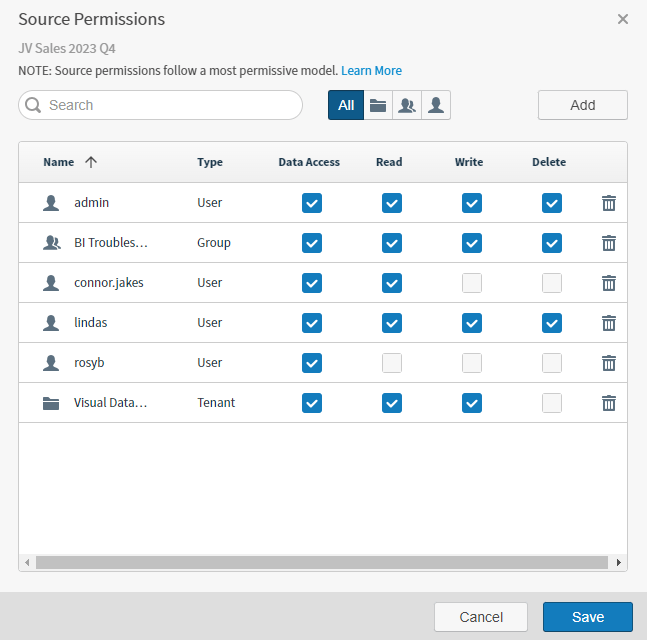
- Members of the Administrators group have data access, read, write, and delete permissions for every data source in the tenant.
- The user who creates a data source is automatically selected and has Data Access, Read, Write, and Delete permissions.
- Select the Data Access, Read, Write, or Delete checkboxes for the tenant, groups, or users to indicate what users in them can do with the data source. Data Access permission is assumed and is always selected. If you clear (uncheck) the check box (revoke Data Access permission), permission for the entire data source is revoked for the tenant, group, or user after you save.
-
Select Save. The Save Details dialog appears, listing the changes that you made.
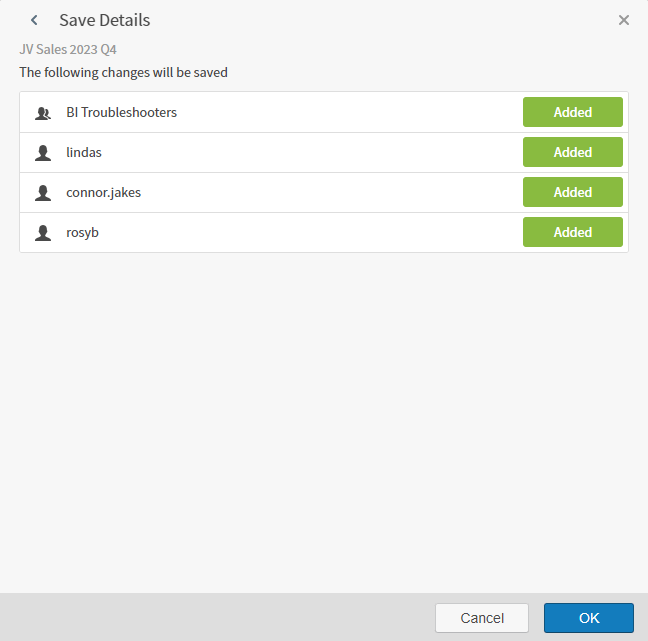
- Review the changes and select OK. The source authorization permissions are set.
Modify Permissions for a Data Source
You can modify the data source permissions you granted to your tenant, to groups in your tenant, or to specific users in your tenant.In this release, when your admin enables the Enhanced Experience user interface, you will see changes to workflows you may have used in previous releases.
- Log in as an administrator or a user belonging to a group that includes the Administer Sources or the Manage Source Permissions privilege. If you are logged in as a tenant admin, verify you’re in or switch to the appropriate tenant.
- Select the Sources card on your home page or Data Sources from the main menu. The Sources work area opens. Some columns in this work area can be resized or sorted as needed; select the column header break to resize, or select the column name to change the sort.
- Locate the row for the data source in the list and select the permissions icon in the Permissions column. The Source Permissions dialog appears.
-
If you want to add permissions for all users in your tenant or for additional groups or users in your tenant, select Add on the Source Permissions dialog and then select Groups, Users, or Tenant from the drop-down menu.
- If you select Groups, the Add Groups dialog appears, listing all the groups available in your tenant. The supplied groups are not shown; permissions can not be changed for those groups.
- If you select Users, the Add Users dialog appears, listing all the users available in your tenant.
- If you select Tenant, Read permission is selected for your tenant on the Source Permissions dialog.
- Members of the Administrators group have read, write, and delete permissions for every source in the tenant.
- The user who created the source is automatically selected and hasData Access, Read, Write, and Delete permissions unless you revoke these permissions.
- Select the Data Access, Read, Write, or Delete checkboxes for the tenant, groups, or users to indicate what users in them can do with the data source. Data Access permission is assumed and is always selected. If you clear (uncheck) the check box (revoke Data Access permission), permission for the entire data source is revoked for the tenant , group, or user after you save.
- Select Save. The Save Details dialog appears, listing the changes that you made.
- Review the changes and select OK. The source authorization permissions are set.
Revoke Permissions for a Data Source
You can revoke the data source permissions you previously granted to your tenant, to groups in your tenant, or to specific users in your tenant.In this release, when your admin enables the Enhanced Experience user interface, you will see changes to workflows you may have used in previous releases.
- Log in as an administrator or a user belonging to a group that includes the Administer Sources or the Manage Source Permissions privilege. If you are logged in as a tenant admin, verify you’re in or switch to the appropriate tenant.
- Select the Sources card on your home page or Data Sources from the main menu. The Sources work area opens. Some columns in this work area can be resized or sorted as needed; select the column header break to resize, or select the column name to change the sort.
- Locate the row for the data source configuration in the list and select the permissions icon in the Permissions column. The Source Permissions dialog opens.
- To completely revoke all source permissions for the tenant or for a group or user, locate the row for the tenant, group or user on the Source Permissions dialog and select the delete icon. The tenant , group, or user is removed from the dialog. You can also revoke specific permissions by changing the checkbox selections for the tenant or group on the Source Permissions dialog. If you clear (uncheck) the Data Access box (revoke Data Access permission), permission for the entire data source is revoked for the tenant, group, or user after you save. See Modify Permissions for a Data Source.
- Select Save. The Save Details dialog appears, listing the changes that you made.
- Review the changes and select OK. The source authorization permissions are set.